
-

Ti6Al4V Aerospace Structural Parts: 5-Axis Milling Without Stress Surprises
Titanium is not difficult because it is hard. It is difficult because it keeps moving. A Ti6Al4V bracket can measure perfectly on the machine and fail first article inspection two days later, and the reason is almost never the cutter. It is the sequence.
Where titanium punishes the process plan
Ti6Al4V conducts heat poorly, so the cutting edge stays hot while the workpiece stays cool. Tools wear quickly, and a worn tool pushes the surface instead of cutting it, which raises cutting force and induces stress in the part. Add a low modulus and thin ribs, and the part deflects away from the tool before the tool has done anything wrong.
The practical answer is conservative radial engagement, high spindle speed, generous coolant, and a tool change interval based on measured wear rather than on the tool life printed on the box.
Fixturing and material removal
Most aerospace structural parts are pockets and ribs cut from solid. We remove the bulk of the stock in a roughing operation that leaves uniform allowance, then let the part rest before semi-finishing. Five-axis access lets us keep the tool axis short and reach pocket floors and side walls without long overhangs, which is where chatter usually starts.
Fixtures are designed to hold the part on surfaces that will not become functional. Clamping on a thin rib will spring the part when the clamps come off, no matter how careful the finishing pass was. Our process planning approach starts from that constraint.
Holding tolerance after the cut
Stress relief belongs in the plan, not in the rework. Where the drawing allows, we rough, stress-relieve, then finish. Thin walls and narrow slots that cannot tolerate milling load are cut with WEDM-LS, which removes material without mechanical force. Mirror EDM handles small features where surface finish matters and a milling cutter cannot reach. Both routes are routine for titanium and hard-material parts here.
Only after those steps does the part go to final inspection. Measuring a part still clamped in the fixture tells you what the machine did, not what the part is. The same sequence governs other titanium and hard-material parts we quote.
Inspection, traceability and finishing
First article inspection covers every dimension on the drawing, with CMM reports on the critical ones and material certification tied to the heat number. Surface treatment follows the drawing: passivation, anodizing where specified, or none at all when the customer’s coating house takes over.
Low-volume aerospace work is usually a bridge between a design that is still moving and a program that is not yet released. That makes change tolerance part of the service, not a favor. Discuss a titanium part with us before the drawing is released and the sequence can still change.
Writer: Rosie Zou
WhatsApp: +86 138 2729 4028
Email: rosiezou@k-tekmachining.com
-

Precision Turned Parts for EV Charging Connectors
An EV charging connector is a small part with a large job. It has to seat against a plug thousands of times, hold a seal in rain and dust, carry current without heating up, and look like it belongs on a forecourt. Most of that is decided by a lathe and a finishing line.
What the connector body has to do
The body carries the contact, centers the mating plug, and holds the seal that keeps water out of the terminal chamber. Three features do most of the work: the bore that locates the contact, the seal land that sets compression, and the thread or collar that locks the connection. Each has its own tolerance, and the way they stack is what determines whether the plug inserts smoothly or binds at the last few millimeters.
6061-T6 is the usual alloy for the shell: free-machining, stable, and receptive to anodizing. Where a part needs more wear resistance at the contact seat, a stainless insert or a different alloy is specified for that feature alone.
Turning strategy and tolerance stack
Bore, seal land and thread are turned in one setup wherever the geometry allows, because every re-chuck adds runout between features that must be concentric. Bar stock is chosen close to finished diameter to keep the number of passes down and the thermal load low. Seal lands get a dedicated finishing pass with a small nose radius, since surface texture there matters more than dimensional class.
Long, thin shells deflect. Where wall thickness drops below a few millimeters, we support the bore with a mandrel or turn between centers rather than accepting a taper that inspection will find later. The same logic applies to turned and milled connector components with a seal at both ends.
Anodizing that survives outdoor service
Type II anodizing gives color and corrosion resistance, but it also grows the surface and can close a thread or a seal land if the masking plan is careless. Threads, seal lands and electrical contact faces are masked before anodizing; everything that mates is left bare or finished to its own specification.
Color match matters on a forecourt. We work to a sample or a color reference and keep parts from one batch together through the line, because anodizing shade shifts with bath age and part position.
Inspection before shipment
Bore diameter, seal land diameter and surface finish, thread gauge, concentricity between bore and seal land, coating thickness on the anodized areas, and a visual check on color and masking. Parts ship in trays that protect the finished surfaces, because a scratched connector is a rejected connector. Finishing and tolerance questions are collected in our FAQ.
Prototype quantities for connector redesigns are usually small, and the schedule is set by a certification test rather than by a production plan. That suits the way we work. Start a connector project with a drawing and a target test date.
Writer: Rosie Zou
WhatsApp: +86 138 2729 4028
Email: rosiezou@k-tekmachining.com
-

CNC Machined Guide Bushings
K-TEK manufactures custom CNC machined guide bushings for industrial machinery, automation systems, tooling equipment, and precision mechanical assemblies.
Guide bushings provide accurate guidance and support for moving shafts, pins, and other mechanical components. Precise inner diameters, concentricity, and surface finishes help maintain alignment and reduce unwanted movement during operation.
Our CNC turning and milling capabilities support cylindrical guide bushings, flanged bushings, stepped bushings, and customized sleeve geometries according to customer drawings.
Materials: Bronze, brass, stainless steel, carbon steel, alloy steel, and engineering plastics.
Applications: Industrial automation, tooling fixtures, stamping equipment, mechanical guide systems, and precision assembly machinery.
K-TEK supports prototype machining and custom production, with dimensional inspection and surface finish verification available according to project requirements.
Contact K-TEK for custom CNC machined guide bushings manufactured to your technical specifications.
-

5-Axis Machined Aluminum Cold Plates for AI Liquid Cooling
A cold plate is judged by two numbers that have little to do with each other: thermal resistance and leak rate. Both are decided long before the part reaches a test bench. They are decided by alloy, channel geometry, how the plate is closed, and whether the face that touches the chip is still flat afterwards.
Why 6061-T6, and when copper
6061-T6 is the default for aluminum cold plates. It machines cleanly, holds a good finish, and stays stable when cut from stress-relieved stock. For most direct-to-chip plates that is enough conductivity at a weight a rack can carry.
Copper enters when heat flux is high enough that conductivity differences stop being academic, or when loop chemistry rules aluminum out. Copper machines well but moves more under heat, so the plan needs more allowance for stress relief.
Channel geometry that survives the cut
Channel depth is the dimension that matters most, because it sets the wall thickness between coolant and die. A plate with 4 mm channels and a 1 mm wall has no room for deflection. We prove depth with test cuts and first-article measurement rather than trusting the CAM model, and we keep fin thickness consistent across the pattern so flow is even.
Where channels are narrow and deep, a long end mill is the wrong tool. WEDM-LS or mirror EDM cuts the slot without side load, leaving straight walls and a predictable floor. It is slower per feature, but it removes the risk of a scrapped plate late in the process. These are precision machined components built to the drawing, not to a catalog tolerance.
Sealing: vacuum brazing, FSW and post-join machining
Closed internal channels turn the plate into an assembly. Vacuum brazing gives full-face coverage and a clean internal passage, but the thermal cycle distorts the plate; flatness must be re-machined afterwards, and the O-ring groove is usually cut after joining for that reason. Friction stir welding keeps the heat local and avoids filler metal, at the cost of a weld bead that has to be machined back and blended.
Either route ends with the same requirement: the sealing face, the channel floor and the mounting holes must be brought back to one datum after joining. That is why joining is quoted as part of the machining sequence.
Inspection and finishing before shipment
Every plate gets a dimensional report on channel depth, wall thickness, groove profile and flatness across the die footprint, plus a helium leak test after joining and a second check after finishing. Anodizing or chromate conversion goes on the outside only; masking protects the sealing face and the channel, because a coating inside the loop is a particle source. Tolerance and inspection questions that arrive before the order are answered in our FAQ.
Plates ship flat, sealed and traceable, in low volume and on a schedule that survives a revision. Request a cold plate quote with your STEP file and leak specification.
Writer: Rosie Zou
WhatsApp: +86 138 2729 4028
Email: rosiezou@k-tekmachining.com
-

CNC Machined Linear Actuator Housings
K-TEK provides custom CNC machined linear actuator housings for industrial automation, robotics, motion control equipment, and precision machinery.
Linear actuator housings protect and support internal drive components while providing accurate mounting interfaces for motors, bearings, guides, and transmission assemblies.
Our CNC machining capabilities support complex internal cavities, precision bearing seats, threaded holes, mounting surfaces, and customized structural features according to engineering drawings.
Materials: Aluminum 6061/7075, stainless steel, carbon steel, and alloy steel.
Applications: Linear actuators, industrial robots, automated production equipment, positioning systems, and precision motion control assemblies.
K-TEK offers 3-axis, 4-axis, and 5-axis CNC machining services for custom actuator housings, supporting prototypes and low-volume production.
Send us your 2D drawings or 3D models for a custom CNC machining quotation.
-

CNC Machined Cam Follower
K-TEK manufactures custom CNC machined cam follower components for industrial automation, packaging machinery, and precision mechanical motion systems.
Cam follower components are used in cam-driven mechanisms to support controlled movement, positioning, and mechanical synchronization. Accurate shaft dimensions, mounting interfaces, and eccentric features are important for reliable assembly and operation.
Our CNC turning and milling capabilities support custom cam follower shafts, eccentric studs, mounting components, and precision mechanical features according to customer drawings.
Materials: Carbon steel, alloy steel, stainless steel, and other specified machinable metals.
Applications: Packaging machinery, automated assembly equipment, indexing mechanisms, conveyor systems, and industrial motion control equipment.
K-TEK supports prototype development and custom production, with dimensional inspection and CMM measurement available for critical features.
Contact us with your drawings or 3D models for custom CNC machined cam follower components.
-

Precision CNC Machined Drift Racing Suspension and Steering Components
Our precision CNC machined drift racing suspension and steering components are manufactured for vehicles that operate under repeated steering loads, large suspension angles, and aggressive chassis movement. These parts are widely used in drift cars, angle kits, steering knuckles, wheel hubs, suspension arms, differential mounts, subframe supports, and custom chassis modifications. With advanced CNC milling and turning capabilities, we can produce uprights, hub carriers, suspension brackets, steering adapters, spacers, and reinforcement components with complex geometry and accurate mounting relationships.
-

Custom CNC Machined Kart Racing Hub and Chassis Components
Our custom CNC machined kart racing components are designed for lightweight competition vehicles that depend on responsive handling, accurate steering, and reliable drivetrain performance. These parts are commonly used in racing karts, wheel hub systems, axle assemblies, sprocket carriers, steering structures, pedal mechanisms, bearing supports, and chassis adjustment hardware. With precision CNC turning and milling processes, we can manufacture wheel hubs, bearing carriers, axle supports, sprocket adapters, pedal brackets, spacers, and other custom kart components with excellent dimensional consistency.
-

Titanium Alloy CNC Precision Components for Special Robots | Custom High-Strength Corrosion-Resistant Robot Parts
Product Overview
For outdoor exploration, explosion-proof, underwater and heavy-duty special robot scenarios, titanium alloy CNC parts combine lightweight property, ultra-high strength and corrosion resistance. Machined from TC4 titanium alloy via 5-axis CNC precision machining, these parts work as connectors, flanges, sensor brackets and actuator housings under harsh working conditions.
Key Advantages
1. TC4 Titanium Alloy: High strength-to-weight ratio, resistant to seawater, acid & alkali, excellent anti-fatigue performance.
2. Ultra-precision machining: Complex free-form structures, deep holes and thin-wall parts with tight geometric tolerance control.
3. Complete post-processing: CNC machining, polishing and passivation to meet special equipment standards.
4. Small-batch friendly: Special robot R&D orders are mostly low-volume, we support fast prototype delivery.
Applications
Underwater robots, explosion-proof inspection robots, exploration special robots, heavy-duty manipulator connectors
Author Information
Writer: Rosie | Date: Oct 6, 2026 Email: rosiezou@k-tekmachining.com | Web: www.k-tekmachining.com
-

CNC Machined AGV Mobile Robot Chassis | Custom Aluminum Base for AMR Robots
Product Overview
AGV / AMR robot chassis carries the whole power system, batteries, drive wheels and sensors, which requires excellent flatness and rigidity. Our chassis is milled from solid aluminum plate in one CNC operation to eliminate welding deformation and guarantee consistent hole positions for wheel sets and sensors. Suitable for warehouse handling and workshop mobile robots.
Key Advantages
1. Monolithic CNC milling: No welding stress & deformation, controllable chassis flatness to ensure smooth travelling.
2. Pre-machined integrated holes: Mounting holes for motors, LiDAR, cameras and batteries can be fully processed according to your drawings.
3. Surface treatment: Sandblasting + anodizing, scratch-resistant and anti-rust for dusty workshop environments.
4. Custom dimensions: Available from small inspection robots to heavy-duty handling AGV chassis.
Applications
Warehouse AGV, workshop AMR autonomous mobile robots, inspection robot chassis
Author Information
Writer: Rosie | Date: Oct 6, 2026 Email: rosiezou@k-tekmachining.com | Web: www.k-tekmachining.com
-

Aluminum CNC Machined Robot Joint Components | Custom Precision Structural Parts for Collaborative Robotic Arms
Aluminum CNC Machined Robot Joint Components | Custom Precision Structural Parts for Collaborative Robotic Arms
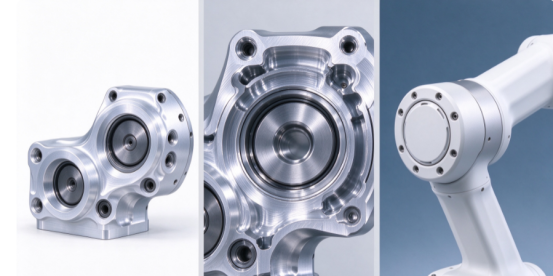
Product Overview
Robot joints serve as the core motion units of robotic arms. This aluminum CNC joint housing is integrally machined from 6061 / 7075 aluminum alloy on 5-axis CNC equipment. It features lightweight design and high rigidity, with anodized finish for anti-corrosion and wear resistance, ideal for collaborative robots and small industrial robotic arms. Customization from drawings or samples available, supporting rapid prototyping & mass production.
Key Advantages
1. Precision: Tolerance up to ±0.005mm. Curved surfaces and mounting holes formed in one operation for smooth joint rotation without jamming.
2. Material: Optional 6061 / 7075 aluminum, light weight and good thermal conductivity to reduce self-load of robots.
3. Processing workflow: 5-axis CNC milling → deburring → sandblasting → hard anodizing to enhance surface hardness.
4. Lead time: 3–7 days for prototype sampling, small & medium batch production supported.
Applications
Collaborative robots, 6-axis industrial robotic arms, educational robots, light-duty robotic arm joint modules
Author Information
Writer: Rosie | Date: Oct 6, 2026 Email: rosiezou@k-tekmachining.com | Web: www.k-tekmachining.com
-

CNC Machined End Caps
Materials: Aluminum, stainless steel, carbon steel, alloy steel, brass, and other engineering materials.
Applications: Electric motors, pumps, gearboxes, reducers, hydraulic systems, automation equipment, and industrial machinery.
K-TEK supports prototype, low-volume, and production orders. Each CNC machined end cap is inspected against the approved drawing, with dimensional reports and CMM inspection available for critical features.



